

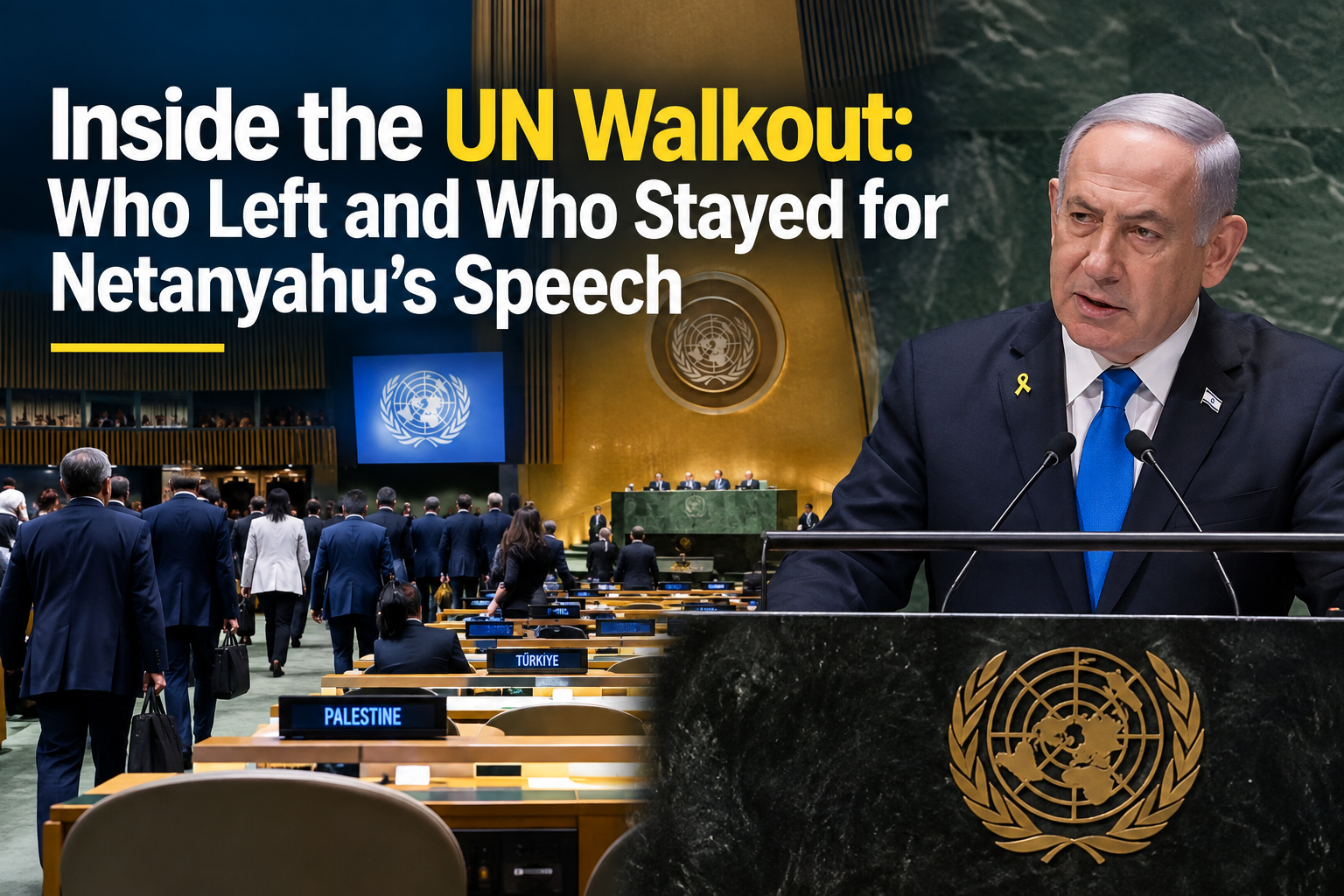
Israeli Prime Minister Benjamin Netanyahu’s address to the United Nations General Assembly on September 24 was marked by a mass diplomatic walkout, with delegations from dozens of countries leaving the chamber as he began speaking. Other governments, including the United States, United Kingdom, France and Germany, remained for the address.
Who Walked Out?
Reports based on footage from the General Assembly indicated that representatives from nearly 70 countries either left the chamber or had seats that remained empty as Netanyahu approached the podium. The exact number varies between reports because some delegations had already left the hall or were represented by only a small number of diplomats.
Countries reported as participating in the walkout included Türkiye, Palestine, Tunisia, Syria, Algeria, Yemen, Egypt, Iraq, Saudi Arabia, Jordan, Iran, Qatar, Lebanon, Malaysia, Indonesia and Kuwait.
Delegations from countries including Spain, Brazil, Peru, Cuba, Nigeria, Ghana, Libya, Bangladesh, Afghanistan, Oman and Niger were also reported to have walked out or left their seats empty.
The Palestinian Mission to the UN had encouraged delegations to protest Netanyahu’s appearance by leaving the chamber, according to multiple reports.
Which Countries Stayed?
The chamber was not completely empty. Representatives of several governments remained throughout Netanyahu’s address.
The United States, Germany, Argentina, Hungary, Serbia, Ukraine, Czechia and Greece were among those reported to have stayed. Representatives of the United Kingdom, France, Ireland, Belgium and Norway also remained in the hall.
The European Union delegation was also reported to have remained. China was represented by a single diplomat, while representatives of the United Arab Emirates and Bahrain also stayed during the speech.
Other countries reported as represented in the chamber included Australia, Austria, Canada, Portugal, Poland, Denmark, Romania, Slovakia, Estonia, Lithuania, Luxembourg, Iceland, Azerbaijan, Kazakhstan, Mexico, Kenya and El Salvador.
Netanyahu Responds to the Walkout
Netanyahu continued his address despite the departures. He directly criticized those leaving the chamber and described them as “moral cowards,” according to reports of his remarks.
His speech focused on Israel’s security, Iran and the wider regional conflict. He also rejected allegations concerning Israel’s conduct in Gaza and criticized several governments over their positions toward Israel.
The walkout occurred against the backdrop of continuing international disagreement over Israel’s military operations in Gaza, its policies in the occupied West Bank and the broader regional conflict.
Why the Walkout Matters
The episode highlighted the diplomatic divisions surrounding Israel at the United Nations. The contrast between the large number of delegations leaving and the governments that remained created one of the most visible moments of the 81st General Assembly session.
At the same time, the presence of the United States and several European and other governments showed that governments continue to take different positions on Israel and Netanyahu’s policies.
The walkout therefore provided a visible snapshot of the competing diplomatic positions surrounding the Gaza war and Israel’s wider regional policy, rather than representing a unanimous position among UN member states.
What’s Next
The UN General Assembly debate continues as governments discuss the Gaza conflict, regional security and the future of the Israeli-Palestinian conflict. The diplomatic divisions displayed during Netanyahu’s speech are expected to remain part of wider discussions over international policy toward Israel and the Middle East.
