

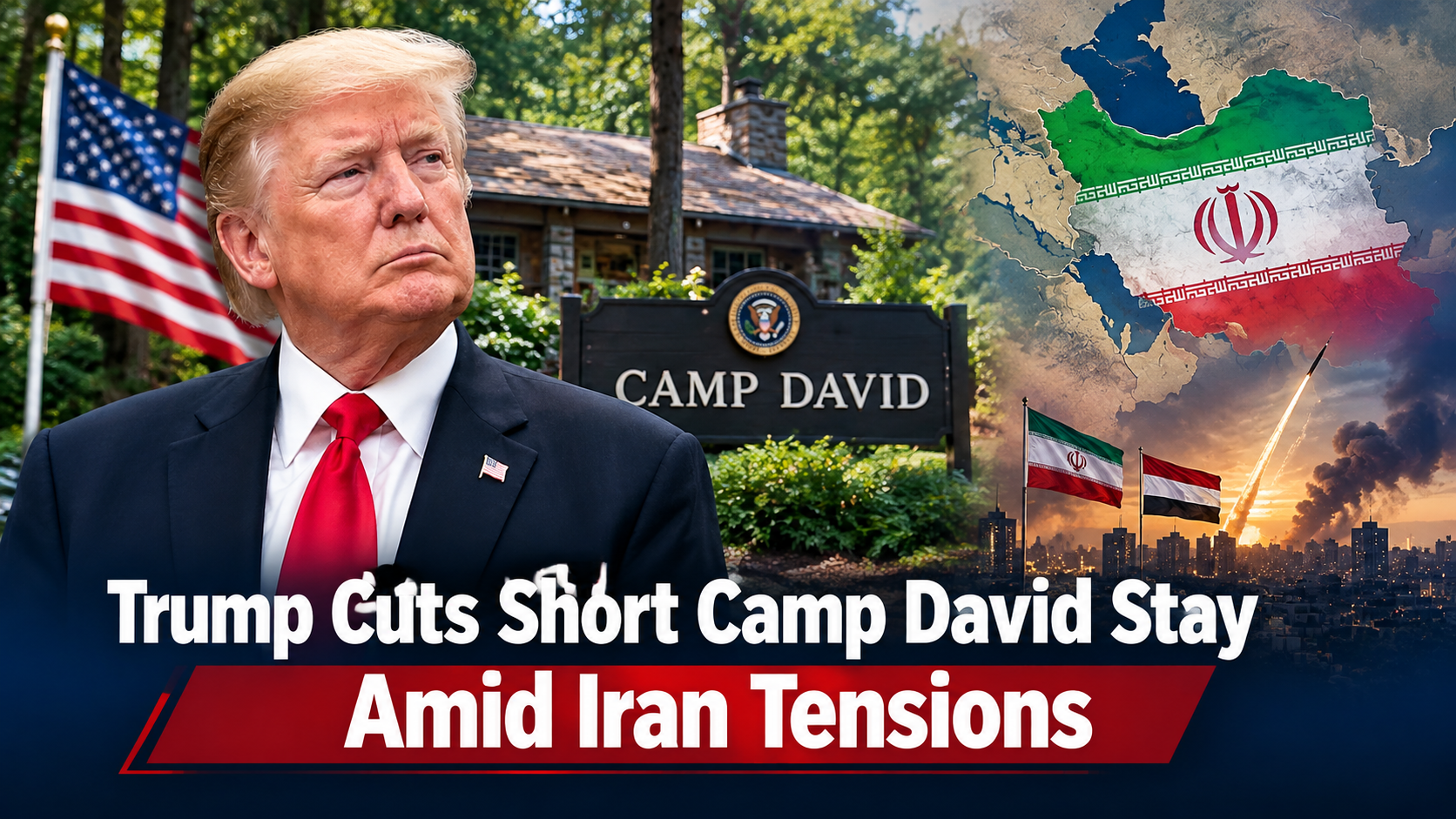
WASHINGTON — September 20, 2026: Trump cuts short Camp David stay as U.S. President Donald Trump returned to the White House on Saturday amid rising tensions involving Iran, Yemen and Saudi Arabia, while Washington weighs its next steps in the widening Middle East conflict. The White House did not publicly give a reason for the change in Trump’s schedule.
Trump had been expected to remain at the presidential retreat in Maryland through Sunday. The White House later updated his schedule to show an earlier return to Washington aboard Marine One.
The decision came as regional tensions rose following a Houthi ballistic missile launch toward Riyadh. Saudi authorities said the missile was intercepted, while alerts were issued in the Saudi capital amid reports of escalating attacks linked to the conflict in Yemen. Reuters reported that a journalist in Riyadh heard two booms during the latest alerts.
The developments have added pressure on Washington as the Trump administration considers its response to the Houthi attacks and the broader confrontation with Iran.
Iran Puts Conditions on Possible Talks
At the same time, Iran has signaled that diplomatic channels remain open, although Tehran has attached conditions to any renewed negotiations with the United States.
Mohsen Rezaei, secretary of Iran’s Supreme National Security Council, said Saturday that Iran had conveyed seven conditions to Washington for starting negotiations. He said the conditions had been communicated through Qatari mediators and that Tehran was waiting for a response from Trump.
Rezaei did not publicly disclose all seven conditions. He separately identified three demands in comments reported by international media: an end to the war on all fronts, the release of frozen Iranian funds and the lifting of the U.S. naval blockade.
Iran’s position comes as the conflict continues to affect regional security and shipping through the Strait of Hormuz, a major route for global energy supplies. Iranian officials have also said the waterway will remain closed until their conditions and U.S. commitments are addressed.
US Issues Middle East Security Warning
The State Department has separately warned Americans about the deteriorating security environment in the Middle East.
A State Department travel advisory urged Americans in the region to exercise heightened vigilance and prepare for possible flight cancellations, airspace closures and other disruptions. It also warned that the conflict involving Iran-backed Houthis and Saudi Arabia could escalate rapidly.
Several U.S. diplomatic missions in the region have issued security alerts as tensions have increased. The warnings reflect concerns that the conflict could affect U.S. interests and personnel beyond the immediate areas of fighting.
Trump’s early departure from Camp David also followed an unrelated security incident near the presidential retreat. A NORAD F-16 intercepted a general aviation aircraft that entered restricted airspace near Thurmont, Maryland. The U.S. military said the aircraft was safely escorted away and that the incident posed no danger to Trump or people on the ground.
What Comes Next
The Trump administration now faces a combination of military and diplomatic considerations as fighting involving Iran and Iran-aligned groups continues across the region.
Iran’s conditions could provide a possible framework for renewed negotiations, but Washington has not publicly accepted Tehran’s demands. At the same time, attacks involving the Houthis and the resulting security concerns in Saudi Arabia are increasing pressure for decisions on the U.S. response.
For now, the White House has not publicly linked Trump’s early return from Camp David to a specific military decision. The change in schedule, however, comes at a sensitive moment as the administration reviews its options and regional governments prepare for the possibility of further escalation.
