

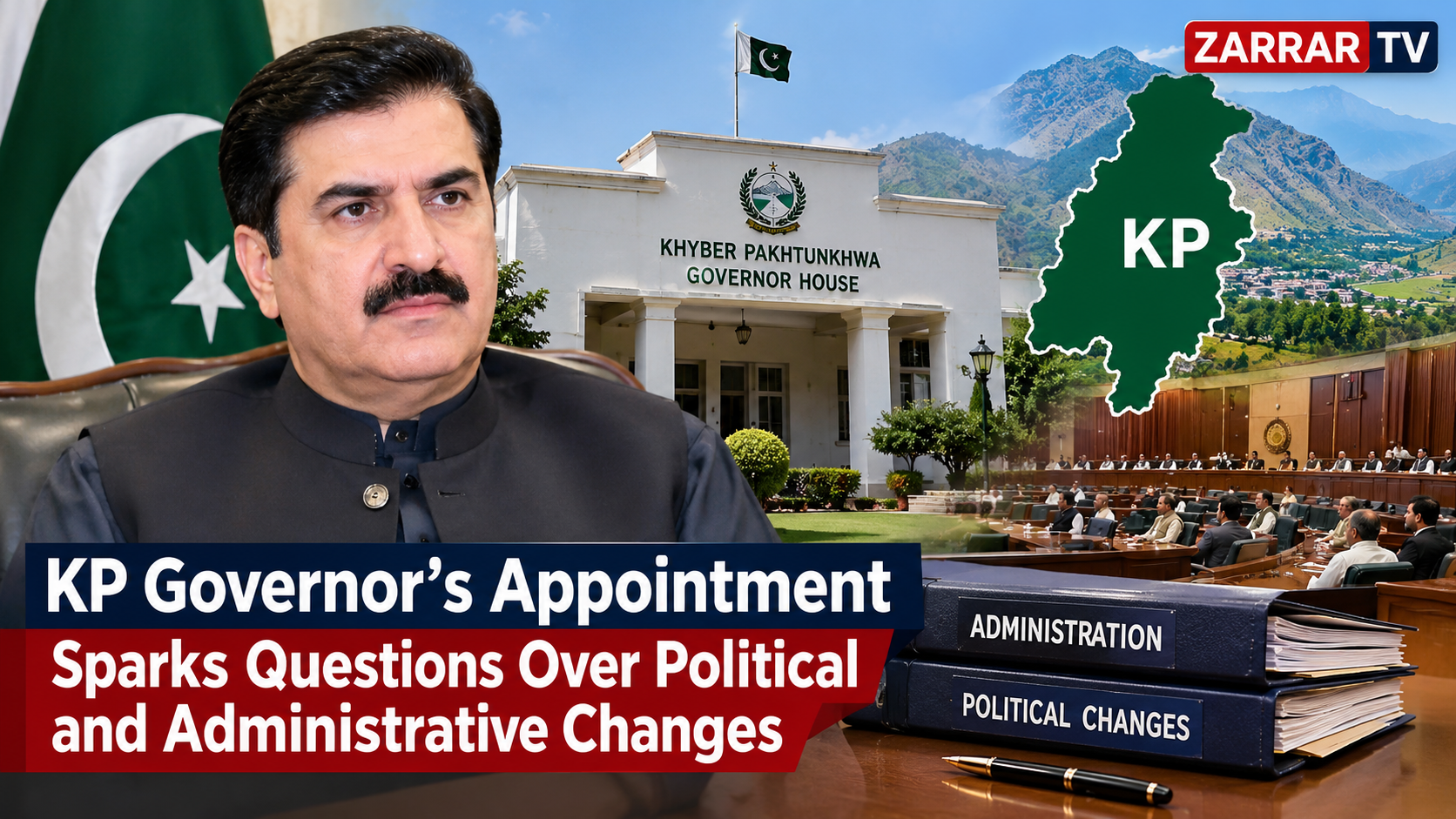
The political and administrative landscape of Khyber Pakhtunkhwa has entered a new phase following the imposition of governor’s rule and the expanded responsibilities assigned to Governor Faisal Karim Kundi. The federal government’s decision on October 11, 2026, has raised questions about provincial governance, political stability, security management and the future relationship between Islamabad and the province.
The developments have placed the province’s administrative structure under renewed scrutiny, with political parties, government officials and citizens closely monitoring how the new arrangement will affect public services and decision-making.
Governor’s Rule Changes the Provincial Administrative Structure
On October 11, President Asif Ali Zardari promulgated emergency and governor’s rule in Khyber Pakhtunkhwa under Articles 232 and 234 of the Constitution, following advice from Prime Minister Shehbaz Sharif.
According to the federal government, the decision was taken in response to security challenges and concerns regarding the provincial administration’s handling of terrorism.
Federal Law Minister Azam Nazeer Tarar announced that the powers previously exercised by the chief minister, provincial cabinet and advisers had been transferred to the governor under the new arrangement.
The decision marked a significant change in the province’s administrative structure, which had been led by the Pakistan Tehreek-e-Insaf (PTI) since 2013.
The federal government also announced the establishment of an 11-member advisory council to assist the governor in managing provincial affairs.
The move has generated political debate over constitutional authority, provincial autonomy and the implications of federal intervention in a province governed by an opposition party. <escape>【turn327848search1】【turn327848search5】</escape>
Faisal Karim Kundi Takes a Central Role in Provincial Affairs
Governor Faisal Karim Kundi has emerged as a central figure in the province’s new administrative arrangement.
Following the federal decision, Kundi chaired the inaugural meeting of the newly constituted advisory council in Peshawar on October 11.
During the meeting, the governor emphasized the restoration of peace, security and stability as key priorities for the province.
He also called for stronger implementation of government decisions, accountability and efforts to improve public service delivery.
The advisory council includes individuals assigned responsibilities across several important departments, including finance, education, health, law, energy, industries, minerals and information.
The new structure is intended to assist the governor in overseeing provincial affairs under the federal government’s administrative framework.
However, the effectiveness of the arrangement will depend on how efficiently the council coordinates with government departments and addresses the province’s longstanding security and development challenges. <escape>【turn327848search7】【turn327848search16】</escape>
Administrative Changes Raise Questions About Governance
The imposition of governor’s rule has been accompanied by changes within the provincial bureaucracy.
The federal government ordered a reshuffle of senior administrative officers following the October 11 decision.
According to reports, several senior officers, including the former chief secretary, were directed to report to the Establishment Division.
Dr Muhammad Fakhr Alam Irfan, a Grade 22 officer of the Pakistan Administrative Service, was appointed as the new chief secretary of Khyber Pakhtunkhwa.
These changes indicate a broader restructuring of the province’s administrative machinery as the federal government seeks to implement its new governance priorities.
The reshuffle has also raised questions about continuity in government operations, institutional coordination and the role of senior bureaucrats in managing provincial affairs.
Administrative changes can influence the implementation of development projects, public-sector policies and service delivery, making the transition particularly important for residents across the province. <escape>【turn327848search5】【turn327848search9】</escape>
Security Remains a Major Challenge for Khyber Pakhtunkhwa
Security is expected to remain one of the most important issues confronting the new administrative arrangement.
Khyber Pakhtunkhwa has experienced persistent security challenges, including militant attacks and violence in several districts.
The federal government cited law and order concerns as a major justification for the imposition of emergency and governor’s rule.
Governor Kundi has also emphasized that restoring peace and eliminating terrorism are among the administration’s top priorities.
The province’s security situation has implications beyond its borders, affecting national stability, economic activity, investment and public confidence.
However, the success of the new arrangement will depend not only on administrative authority but also on effective security coordination, adequate resources and cooperation among relevant institutions.
Local communities will be closely watching whether the new administration can improve security conditions and ensure that essential public services continue without disruption. <escape>【turn327848search1】【turn327848search7】</escape>
Political Tensions and Provincial Autonomy
The imposition of governor’s rule has intensified political tensions between the federal government and PTI.
The party has rejected the decision, while opposition figures have raised concerns about the implications for democratic governance and provincial autonomy.
The development has also renewed debate over the constitutional relationship between the federation and the provinces.
Under Pakistan’s parliamentary system, provincial governments exercise authority through elected assemblies and their chief ministers.
The current arrangement has therefore raised questions about how political representation, administrative authority and constitutional responsibilities will operate during the period of governor’s rule.
The situation is likely to remain politically sensitive, particularly as parties continue to disagree over the circumstances that led to the federal intervention.
Any future decisions regarding the province’s political structure will require careful consideration of constitutional provisions and the interests of its residents. <escape>【turn327848search12】【turn327848news21】</escape>
What Comes Next for Khyber Pakhtunkhwa?
The coming weeks will be important in determining how the new administrative arrangement functions.
The governor and advisory council will face pressure to demonstrate improvements in security, governance and public service delivery.
Key areas to watch include:
- The implementation of security measures across the province.
- The performance of the newly formed advisory council.
- Further changes within the provincial bureaucracy.
- The impact of governor’s rule on development projects and public services.
- Political negotiations between the federal government and opposition parties.
- Future constitutional and administrative decisions concerning the province.
The governor’s expanded role has placed Khyber Pakhtunkhwa at the centre of Pakistan’s political debate.
While the federal government has presented the arrangement as a response to security and governance concerns, its longer-term implications will depend on administrative performance, political developments and the restoration of stability.
For residents of Khyber Pakhtunkhwa, the central question remains whether the new arrangement will translate into better security, more effective governance and tangible improvements in everyday life.
As political discussions continue, the province’s future will depend on how its leadership manages the balance between security, constitutional responsibilities, political representation and public welfare.
