

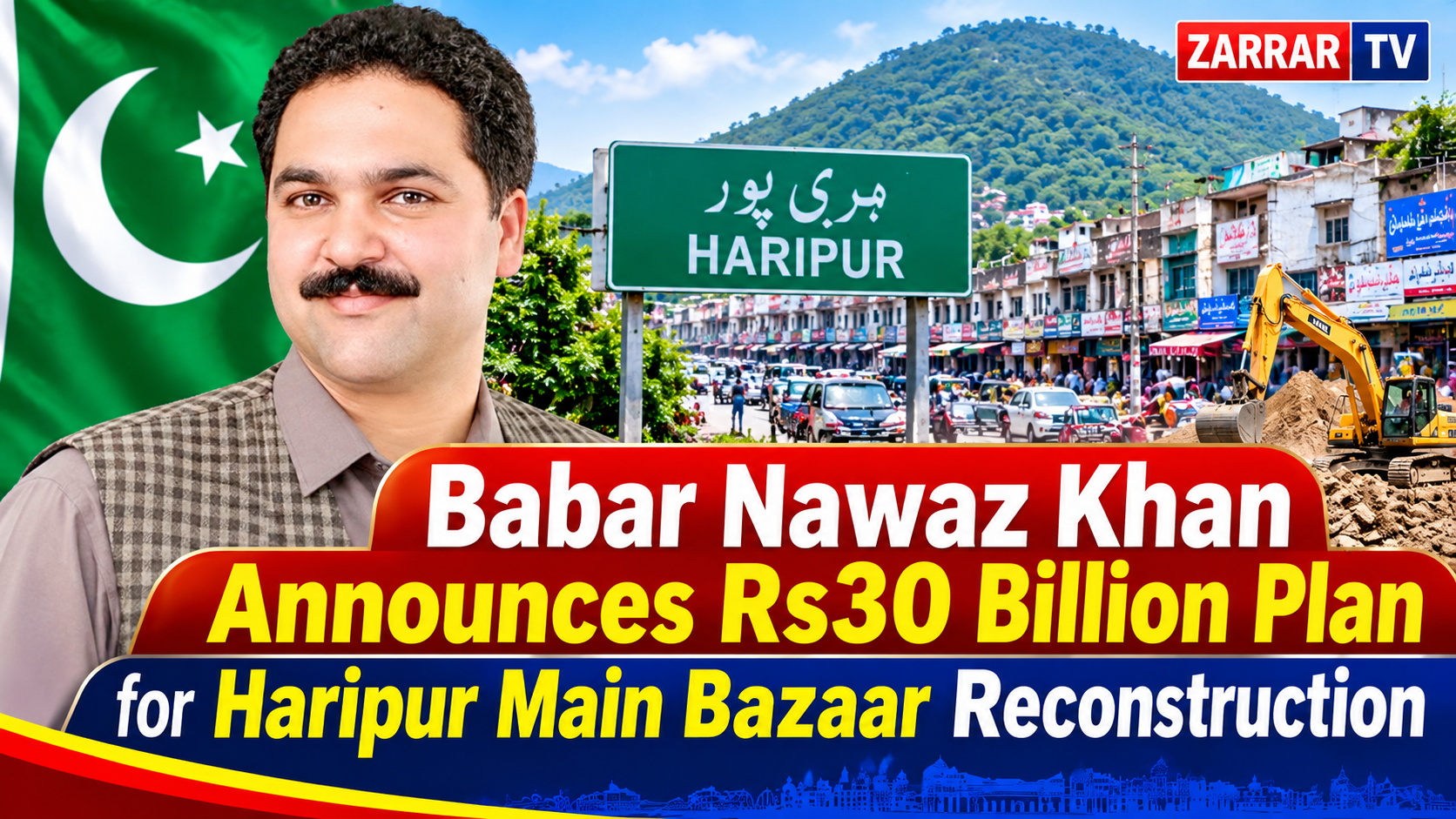
HARIPUR, Pakistan — Pakistan Muslim League-Nawaz lawmaker Babar Nawaz Khan has announced a proposed Rs30 billion plan for the reconstruction and development of Haripur’s Main Bazaar, placing the city’s busy commercial centre at the centre of a major urban improvement agenda. Details of the proposed funding, approval process and implementation schedule have not yet been independently confirmed.
The announcement comes as Haripur faces renewed attention over the condition, use and management of public spaces in its central markets. The Main Bazaar is an important commercial area for local shopkeepers, customers and people travelling into the city for everyday services across the wider district. Any reconstruction programme there could have consequences for business activity, traffic movement and access to shops.
Khan’s proposal is being presented as a development initiative focused on the Main Bazaar. However, a detailed project document setting out the work to be undertaken, the source of the Rs30 billion allocation, or the agencies responsible for delivery was not available at the time of writing. It is therefore not clear whether the figure represents an initial estimate, a proposed package covering several components, or funding that has been formally approved.
For residents and traders, the practical questions will be how the plan is designed and how construction would be managed. A project of this scale would normally require a clear scope of work, engineering assessments, cost estimates, procurement arrangements and approvals from the relevant authorities. Public disclosure of these details would help residents understand what improvements are planned and how public money would be used.
The announcement also comes amid a wider debate over the future of Haripur’s commercial streets. Recent reporting has highlighted the impact of anti-encroachment operations in the city, including disruption to traders and businesses during the removal of structures from public spaces. The Express Tribune reported on November 7 that the demolition drive had affected markets and caused distress among traders. The News also reported earlier in November on arrests linked to resistance against an anti-encroachment operation in the Main Bazaar.
These developments underline the importance of linking enforcement with a transparent and workable urban plan. Clearing or widening public spaces may address access and congestion, but long-term improvements also depend on safe pedestrian routes, organised parking, drainage, lighting, waste management and suitable arrangements for loading and unloading goods. These are possible considerations for a bazaar redevelopment project; they should not be treated as confirmed features of Khan’s proposal unless included in an official plan.
The Rs30 billion figure, if translated into an approved and funded programme, would represent a substantial public investment. Its impact would depend on the final design, the quality of construction, oversight and the ability of authorities to keep businesses operating during the work. Consultation with traders, residents, transport operators and relevant civic bodies would also be important to reduce disruption and identify local priorities.
No official timeline, phase-wise breakdown, tender details or completion date for the proposed Main Bazaar project had been confirmed in the information available for this report. The relevant authorities would need to clarify whether the proposal has been submitted for formal approval and which government department or local body would oversee implementation.
For now, the announcement has put the future of Haripur’s Main Bazaar in focus. Traders and residents will be looking for a published project plan that explains the proposed improvements, funding status, safeguards for affected businesses and expected timeline. Until those details are made public, the Rs30 billion initiative remains an announced proposal rather than a verified, fully approved development project.
